Thursday, November 09, 2006

ANG NALALAPIT NA CHURCH ANNIVERSARY NG QUEZON CITY

Idalangin natin ang anibersaryo ng Iglesia ng Dios sa Quezon City na gaganapin sa Nov. 19, 2006. Nawa maging matagumpay ang gawain nayan. Ang Dios nawa ang magligtas ng mga kaluluwa at magpatibay sa mga kapatiran diyan sa lugar na yan. Idalangin natin ang kanilang pastor na si Bro. Boyet Faustino na lalo siyang gamitin na malinis na kasangkapan sa pangangaral ng Kanyang Ebangelyo.

ANG DIYOS AY NAGPAPAGALING

Purihin at pasalamatan natin ang Dios sa pagpapagaling niya kay Bro. Charlie Caburian. Siya ay pinagaling sa UTI noong Nov. 3, 2006. Dahil sa pagtitiwala niya sa Panginoon, ayaw niyang uminom ng gamot at magpa Doktor. Kaya pinapirma siya ng waiver ng mga pinuno ng Juvenile sa Muntilupa. Kung sakaling may mangyari sa kanya wala silang pananagutan. Ngunit ang Dios ay gumawa ng himala pagkatapos ng limang araw siya ay lubusang pinagaling ng Panginoon. Ito'y isang malaking hamon sa atin na magtiwala sa kapangyarihan ng Dios. Dakila ang kanyang katapatan sa kanyang mga anak. Purihin ang Dios.
Idalangin natin ang magkapatid na ito na bago mag convention mabigyan sila ng parol. Pag may susuporta sa kanila at mangangalaga sa kanila maaring sa lalong madaling panahon ay mapapalaya sila bago matapos ang taong ito. Sa araw na ito nakausap ko ang parol section sa La Trinidad, Benguet na kung may papatnubay sa kanila at susuporta sa kanilang pangangailangan sila ay bibigyan na sila ng parol. Kaya idalangin natin ang magkapatid na ito na ang Dios ang tutugon sa kanilang pangangailangan. Nawa humipo siya ng mga taong tutulong sa kanila. Nakita ko ang katapatan ng magkapatid na ito. Alam ko ang Dios di sila pababayaan. Idalangin natin sila mga kapatid.

THE CURE OF EVIL-SPEAKING

The Sermons of John Wesley 1872 Edition
SERMON FORTY-NINE

The Cure of Evil-Speaking


"If thy brother shall sin against thee, go and tell him his fault between thee and him alone: If he shall hear thee, thou hast gained thy brother. But if he will not hear, take with thee one or two more, that in the mouth of two or three witnesses every word may be established. And if he will not hear them, tell it to the Church. But if he does not hear the church, let him be to thee as an heathen man and a publican." Matt. 18:15-17

1. "Speak evil of no man," says the great Apostle: -- As plain a command as, "Thou shalt do no murder." But who, even among Christians, regards this command? Yea, how few are there that so much as understand it? What is evil-speaking? It is not, as some suppose, the same with lying or slandering. All a man says may be as true as the Bible; and yet the saying of it is evil-speaking. For evil-speaking is neither more nor less than speaking evil of an absent person; relating something evil, which was really done or said by one that is not present when it is related. Suppose, having seen a man drunk, or heard him curse or swear, I tell this when he is absent; it is evil-speaking. In our language this is also, by an extremely proper name, termed backbiting. Nor is there any material difference between this and what we usually style tale-bearing. If the tale be delivered in a soft and quiet manner (perhaps with expressions of good-will to the person, and of hope that things may not be quite so bad,) then we call it whispering. But in whatever manner it be done, the thing is the same; -- the same in substance, if not in circumstance. Still it is evil-speaking; still this command, "Speak evil of no man," is trampled under foot; if we relate to another the fault of a third person, when he is not present to answer for himself.

2. And how extremely common is this sin, among all orders and degrees of men! How do high and low, rich and poor, wise and foolish, learned and unlearned, run into it continually! Persons who differ from each other in all things else, nevertheless agree in this. How few are there that can testify before God, "I am clear in this matter; I have always set a watch before my mouth, and kept the door of my lips!" What conversation do you hear, of any considerable length, whereof evil-speaking is not one ingredient? and that even among persons who, in the general, have the fear of God before their eyes, and do really desire to have a conscience void of offence toward God and toward man.

3. And the very commonness of this sin makes it difficult to be avoided. As we are encompassed with it on every side, so, if we are not deeply sensible of the danger, and continually guarding against it, we are liable to be carried away by the torrent. In this instance, almost the whole of mankind is, as it were, in a conspiracy against us. And their example steals upon us, we know not how; so that we insensibly slide into the imitation of it. Besides, it is recommended from within as well as from without. There is scarce any wrong temper in the mind of man, which may not be occasionally gratified by it, and consequently incline us to it. It gratifies our pride, to relate those faults of others whereof we think ourselves not to be guilty. Anger, resentment, and all unkind tempers, are indulged by speaking against those with whom we are displeased; and, in many cases, by reciting the sins of their neighbors, men indulge their own foolish and hurtful desires.

4. Evil-speaking is the more difficult to be avoided, because it frequently attacks us in disguise. We speak thus out of a noble, generous (it is well if we do not say,) holy indignation, against these vile creatures! We commit sin from mere hatred of sin! We serve the devil out of pure zeal for God! It is merely in order to punish the wicked that we run into this wickedness. "So do the passions" (as one speaks) "all justify themselves," and palm sin upon us under the veil of holiness!
5. But is there no way to avoid the snare? Unquestionably there is. Our blessed Lord has marked out a plain way for His followers, in the words above recited. None, who warily and steadily walk in this path, will ever fall into evil-speaking. This rule is either an infallible preventive, or a certain cure of it. In the preceding verses, our Lord had said, "Woe to the world, because of offences," -- unspeakable misery will arise in the world from this baleful fountain: (Offences are all things whereby anyone is turned out of, or hindered in, the ways of God.): "For it must be that offenses come," -- Such is the nature of things; such the wickedness, folly, and weakness of mankind: "But woe to that man," -- miserable is that man, "by whom the offense cometh." "Wherefore if thy hand, thy foot, thine eye, cause thee to offend," -- if the most dear enjoyment, the most beloved and useful person, turn thee out of or hinder thee in the way, "pluck it out," -- cut them off, and cast them from thee. But how can we avoid giving offense to some, and being offended at others? Especially, suppose they are quite in the wrong, and we see it with our own eyes? Our Lord here teaches us how: He lays down a sure method of avoiding offenses and evil-speaking together. "If thy brother shall sin against thee, go and tell him of his fault, between thee and him alone: If he will hear thee, thou hast gained thy brother. But if he will not hear thee, take with thee one or two more, that by the mouth of two or three witnesses every word may be established. And if he will not hear them, tell it to the church: But if he will not hear the Church, let him be to thee as an heathen man and a publican."

I. 1. First, "If thy brother shall sin against thee, go and tell him of his fault, between thee and him alone." The most literal way of following this first rule, where it is practicable, is the best: Therefore, if thou seest with thine own eyes a brother, a fellow Christian, commit undeniable sin, or hearest it with thine own ears, so that it is impossible for thee to doubt the fact, then thy part is plain: Take the very first opportunity of going to him; and, if thou canst have access, "tell him of his fault between thee and him alone." Indeed, great care is to be taken that this is done in a right spirit, and in a right manner. The success of a reproof greatly depends on the spirit wherein it is given. Be not, therefore, wanting in earnest prayer to God, that it may be given in a lowly spirit; with a deep, piercing conviction, that it is God alone who maketh thee to differ; and that if any good be done by what is now spoken, God doeth it himself. Pray that he would guard thy heart, enlighten thy mind, and direct thy tongue to such words as he may please to bless. See that thou speak in a meek as well as a lowly spirit; for the wrath of man worketh not the righteousness of God." If he be "overtaken in a fault," he can no otherwise be restored, than "in the spirit of meekness." If he opposes the truth, yet he cannot be brought to the knowledge thereof, but by gentleness. Still speak in a spirit of tender love, "which many waters cannot quench." If love is not conquered, it conquers all things. Who can tell the force of love?
Love can bow down the stubborn neck, The stone to flesh convert;Soften, and melt, and pierce and break An adamantine heart. Confirm, then, your love toward him, and you will thereby "heap coals of fire upon his head."

2. But see that the manner also wherein you speak be according to the Gospel of Christ. Avoid everything in look, gesture, word, and tone of voice, that savors of pride or self-sufficiency. Studiously avoid everything magisterial or dogmatical, everything that looks like arrogance or assuming. Beware of the most distant approach to disdain, overbearing, or contempt. With equal care avoid all appearance of anger; and though you use great plainness of speech, yet let there be no reproach, no railing accusation, no token of any warmth but that of love. Above all, let there be no shadow of hate or ill-will, no bitterness or sourness of expression; but use the air and language of sweetness, as well as gentleness, that all may appear to flow from love in the heart. And yet this sweetness need not hinder your speaking in the most serious and solemn manner; as far as may be, in the very words of the oracles of God (for there are none like them,) and as under the eye of Him who is coming to judge the quick and dead.

3. If you have not an opportunity of speaking to him in person, or cannot have access, you may do it by a messenger; by a common friend, in whose prudence, as well as uprightness, you can thoroughly confide. Such a person, speaking in your name, and in the spirit and manner above described, may answer the same end, and, in a good degree, supply your lack of service. Only beware you do not feign the want of opportunity, in order to shun the cross; neither take it for granted that you cannot have access, without ever making the trial. Whenever you can speak in your own person, it is far better. But you should rather do it by another, than not at all: This way is better than none.

4. But what, if you can neither speak yourself, nor find such a messenger as you can confide in? If this is really the case, it then only remains to write. And there may be some circumstances which make this the most advisable way of speaking. One of these circumstances is, when the person with whom we have to do is of so warm and impetuous a temper as does not easily bear reproof, especially from an equal or inferior. But it may be so introduced and softened in writing as to make it far more tolerable. Besides, many will read the very same words, which they could not bear to hear. It does not give so violent a shock to their pride, nor so sensibly touch their honor. And suppose it makes little impression at first, they will, perhaps, give it a second reading, and, upon farther consideration, lay to heart what before they disregarded. If you add your name, this is nearly the same thing as going to him, and speaking in person. And this should always be done, unless it be rendered improper by some very particular reason.

5. It should be well observed, not only that this is a step which our Lord absolutely commands us to take, but that he commands us to take this step first, before we attempt any other. No alternative is allowed, no choice of anything else: This is the way; walk thou in it. It is true, he enjoins us, if need require, to take two other steps; but they are to be taken successively after this step, and neither of them before it: Much less are we to take any other step, either before or beside this. To do anything else, or not to do this, is, therefore, equally inexcusable.

6. Do not think to excuse yourself for taking an entirely different step, by saying, "Why, I did not speak to anyone, till I was so burdened that I could not refrain." You was burdened! It was no wonder you should, unless your conscience was seared; for you was under the guilt of sin, of disobeying a plain commandment of God! You ought immediately to have gone, and told "your brother of his fault between you and him alone." If you did not, how should you be other than burdened (unless your heart was utterly hardened,) while you was trampling the command of God under foot, and "hating your brother in your heart?" And what a way have you found to unburden yourself? God reproves you for a sin of omission, for not telling your brother of his fault; and you comfort yourself under His reproof by a sin of commission, by telling your brother's fault to another person! Ease bought by sin is a dear purchase! I trust in God, you will have no ease, but will be burdened so much the more, till you "go to your brother and tell him," and no one else.

7. I know but of one exception to this rule: There may be a peculiar case, wherein it is necessary to accuse the guilty, though absent, in order to preserve the innocent. For instance: You are acquainted with the design which a man has against the property or life of his neighbor. Now, the case may be so circumstanced, that there is no other way of hindering that design from taking effect, but the making it known, without delay, to him against whom it is laid. In this case, therefore, this rule is set aside, as is that of the Apostle, "Speak evil of no man:" and it is lawful, yea, it is our bounden duty, to speak evil of an absent person, in order to prevent his doing evil to others and himself at the same time. But remember, meanwhile that all evil-speaking is, in its own nature, deadly poison. Therefore if you are sometimes constrained to use it as a medicine, yet use it with fear and trembling; seeing it is so dangerous a medicine, that nothing but absolute necessity can excuse your using it at all. Accordingly, use it as seldom as possible; never but when there is such a necessity: And even then use as little of it as is possible; only so much as is necessary for the end proposed. At all other times, "go and tell him of his fault between thee and him alone."

II. 1. But what, "if he will not hear?" If he repay evil for good? If he be enraged rather than convinced? What, if he hear to no purpose, and go on still in the evil of his way? We must expect this will frequently be the case; the mildest and tenderest reproof will have no effect; but the blessing we wished for another will return into our own bosom. And what are we to do then? Our Lord has given us a clear and full direction. Then "take with thee one or two more:" This is the second step. Take one or two whom you know to be of a loving spirit, lovers of God and of their neighbor. See, likewise, that they be of a lowly spirit, and "clothed with humility." Let them also be such as are meek and gentle, patient and longsuffering; not apt to "return evil for evil, or railing for railing, but contrariwise blessing." Let them be men of understanding, such as are endued with wisdom from above; and men unbiased, free from partiality, free from prejudice of any kind. Care should likewise be taken, that both the persons and their characters be well known to him: And let those that are acceptable to him be chosen preferable to any others.

2. Love will dictate the manner wherein they should proceed, according to the nature of the case. Nor can any one particular manner be prescribed for all cases. But perhaps, in general, one might advise, before they enter upon the thing itself, let them mildly and affectionately declare that they have no anger or prejudice toward him, and that it is merely from a principle of goodwill that they now come, or at all concern themselves with his affairs. To make this the more apparent, they might then calmly attend to your repetition of your former conversation with him, and to what he said in his own defense, before they attempted to determine anything. After this they would be better able to judge in what manner to proceed, "that by the mouth of two or three witnesses, every word might be established;" that whatever you have said may have its full force by the additional weight of their authority.

3. In order to this, may they not, (1.) Briefly repeat what you spoke, and what he answered? (2.) Enlarge upon, open, and confirm the reasons which you had given? (3.) Give weight to your reproof, showing how just, how kind, and how seasonable it was? And, lastly, enforce the advices and persuasions which you had annexed to it? And these may likewise hereafter, if need should require, bear witness of what was spoken.

4. With regard to this, as well as the preceding rule, we may observe that our Lord gives us no choice, leaves us no alternative, but expressly commands us to do this, and nothing else in the place of it. He likewise directs us when to do this; neither sooner nor later; namely, after we have taken the first, and before we have taken the third step. It is then only that we are authorized to relate the evil another has done, to those whom we desire to bear a part with us in this great instance of brotherly love. But let us have a care how we relate it to any other person, till both these steps have been taken. If we neglect to take these, or if we take any others, what wonder if we are burdened still? For we are sinners against God, and against our neighbor; and how fairly soever we may color it, yet, if we have any conscience, our sin will find us out, and bring a burden upon our soul.

III. 1. That we may be thoroughly instructed in this weighty affair, our Lord has given us a still farther direction: "If he will not hear them," then, and not till then, "tell it to the church." This is the third step. All the question is, how this word, "the church," is here to be understood. But the very nature of the thing will determine this beyond all reasonable doubt. You cannot tell it to the national Church, the whole body of men termed "the Church of England." Neither would it answer any Christian end if you could; this, therefore, is not the meaning of the word. Neither can you tell it to that whole body of people in England with whom you have a more immediate connection. Nor, indeed, would this answer any good end: The word, therefore, is not to be understood thus. It would not answer any valuable end to tell the faults of every particular member to the church (if you would so term it,) the congregation or society, united together in London. It remains that you tell it to the elder or elders of the church, to those who are overseers of that flock of Christ to which you both belong, who watch over yours and his soul, "as they that must give account." And this should be done, if it conveniently can, in the presence of the person concerned, and, though plainly, yet with all the tenderness and love which the nature of the thing will admit. It properly belongs to their office, to determine concerning the behavior of those under their care, and to rebuke, according to the demerit of the offense, "with all authority." When, therefore, you have done this, you have done all which the Word of God, or the law of love, requireth of you: You are not now partaker of his sin; but if he perish, his blood is on his own head.

2. Here, also, let it be observed, that this, and no other, is the third step which we are to take; and that we are to take it in its order after the other two; not before the second, much less the first, unless in some very particular circumstance. Indeed, in one case, the second step may coincide with this: They may be, in a manner, one and the same. The elder or elders of the church may be so connected with the offending brother, that they may set aside the necessity, and supply the place, of the one or two witnesses; so that it may suffice to tell it to them, after you have told it to your brother, "between you and him alone."

3. When you have done this, you have delivered your own soul. "If he will not hear the church," if he persist in his sin, "let him be to thee as an heathen man and a publican." You are under no obligation to think of him any more; only when you commend him to God in prayer. You need not speak of him any more, but leave him to his own Master. Indeed, you still owe to him, as to all other heathens, earnest, tender goodwill. You owe him courtesy, and, as occasion offers, all the offices of humanity. But have no friendship, no familiarity with him; no other intercourse than with an open Heathen.

4. But if this be the rule by which Christians walk, which is the land where Christians live? A few you may possibly find scattered up and down, who make a conscience of observing it. But how very few! How thinly scattered upon the face of the earth! And where is there any body of men that universally walk thereby? Can we find them in Europe? Or, to go no farther, in Great Britain or Ireland? I fear not: I fear we may search these kingdoms throughout, and yet search in vain. Alas for the Christian world! Alas for Protestants, for Reformed Christians! O, "who will rise up with me against the wicked?" "Who will take God's part" against the evil-speakers? Art thou the man? By the grace of God, wilt thou be one who art not carried away by the torrent? Art thou fully determined, God being thy helper, from this very hour to set a watch, a continual "watch, before thy mouth, and keep the door of thy lips?" From this hour wilt thou walk by this rule, "Speaking evil of no man?" If thou seest thy brother do evil, wilt thou "tell him of his fault between thee and him alone?" Afterwards, "take one or two witnesses," and then only "tell it to the church?" If this be the full purpose of thy heart, then learn one lesson well, "Hear evil of no man." If there were no hearers, there would be no speakers, of evil. And is not (according to the vulgar proverb) the receiver as bad as the thief? If, then, any begin to speak evil in thy hearing, check him immediately. Refuse to hear the voice of the charmer, charm he never so sweetly; let him use ever so soft a manner, so mild an accent, ever so many professions of goodwill for him whom he is stabbing in the dark, whom he smiteth under the fifth rib! Resolutely refuse to hear, though the whisperer complain of being "burdened till he speak." Burdened! thou fool! dost thou travail with thy cursed secret, as a woman travaileth with child? Go, then, and be delivered of thy burden in the way the Lord hath ordained! First, "go and tell thy brother of his fault between thee and him alone.:" next, "take with thee one or two" common friends, and tell him in their presence: If neither of these steps take effect, then "tell it to the church." But, at the peril of thy soul, tell it to no one else, either before or after, unless in that one exempt case, when it is absolutely needful to preserve the innocent! Why shouldst thou burden another as well as thyself, by making him partaker of thy sin?

5. O that all you who bear the reproach of Christ, who are in derision called Methodists, would set an example to the Christian world, so called, at least in this one instance! Put ye away evil-speaking, talebearing, whispering: Let none of them proceed out of your mouth! See that you "speak evil of no man;" of the absent, nothing but good. If ye must be distinguished, whether ye will or no, let this be the distinguishing mark of a Methodist: "He censures no man behind his back: By this fruit ye may know him." What a blessed effect of this self-denial should we quickly feel in our hearts! How would our "peace flow as a river," when we thus "followed peace with all men!" How would the love of God abound in our own souls, while we thus confirmed our love to our brethren! And what an effect would it have on all that were united together in the name of the Lord Jesus! How would brotherly love continually increase, when this grand hindrance of it was removed! All the members of Christ's mystical body would then naturally care for each other. "If one member suffered, all would suffer with it; if one was honored, all would rejoice with it;" and everyone would love his brother "with a pure heart fervently." Nor is this all: But what an effect might this have, even on the wild unthinking world! How soon would they descry in us, what they could not find among all the thousands of their brethren, and cry (as Julian the Apostate to his heathen courtiers,) "See how these Christians love one another!" By this chiefly would God convince the world, and prepare them also for His kingdom; as we may easily learn from those remarkable words in our Lord's last, solemn prayer: "I pray for them who will believe in me, that they all may be one, as thou, Father, art in me, and I in thee; that the world may believe that thou hast sent me!" [John 17:21] The Lord hasten the time! The Lord enable us thus to love one another, not only "in word and in tongue, but in deed and in truth," even as Christ hath loved us.

Thursday, October 12, 2006

PATOTOO NI TATAY RODRIGO BANIZA

Ako po si Rodrigo Baniza, nakatira sa km. 3, Pico, La Trinidad Benguet. Ito ang aking patotoo. Noong hindi pa ako tumatanggap sa Panginoon ako ay napakasamang tao. Buti na lang at nakilala ko rin ang Panginoon at binago niya ang aking buhay.

Pumasok ako sa isang sekta ng mga Pentecostal ngunit hindi sila nagtututo ng katulad sa turo ng Iglesia ng Dios. Ayon sa kanila kahit kristiano ka na nagkakasala ka pa rin. Ngunit noong narinig ko ang itinuturo sa Iglesia ng Dios na ang isang cristiano ay di na nagkakasala. Kaya tinanggap ko ang Panginoon at inalis na ako sa kasalanan.

Alam ko na ang Iglesia ng Dios ang nagtuturo ng totoong tunay na Salita ng Dios. Ito ang nakita kong kaibahan nila sa lahat ng mga sekta ng relihiyon. Kaya kung di pa kayo tumanggap sa Panginoon, tanggapin ninyo Siya bilang sariling taga-pagligtas sa inyong buhay. Kayong mga nakikinig dito sa The Way of Truth Broadcast nawa tanggapin nyo Siya. Purihin ang Panginoon.

(Si Tatay Rodrigo Baniza ang unang bunga ng ating Radio Ministry dito sa Benguet. Pumayag siya na gumawa kami ng pansamantalang kapilya sa gilid ng kanilang bahay. Basahin ninyo ang tungkol sa isyu na Mt. Zion. Ipanalangin natin sya at ang buong sambahayan niya na nawa sila rin maligtas)

Wednesday, October 11, 2006

I AM A PILGRIM

I would like to dedicate this piece of oration to all the believers who are struggling to live for Christ in this present world and may it help a little to lift you up your spiritual life.

Who am I? Why am I here? Where am I going? What is my citizenship? I am proud to tell you that I am a citizen of heaven. I am a pilgrim of this world. This world is not really my home, I’m just passing through. I have an important mission on this earth. The Lord commissioned me to sow the seeds of goodness all over the land. While on my way home, I would like to help my fellow pilgrims to finish the journey successfully ant to convert others to become a pilgrim as we are.

How did I become a pilgrim? By nature I was a sinner like others and traveled the way to hell. My former master was the prince of the power of the air, the spirit that works in the children of disobedience. I had my life style according to the lust of the flesh and by nature a child of wrath.

But while I was traveling in the byways in the valley of death I met the Savior. He gave me peace in my troubled heart. He gave me rest in my soul. He told me that I’m no longer a child of the Devil but a child of God. He showed me the way to the father. He himself is the way. I made his word as the lamp of my feet and the light of my path. He placed me in the highway of Holiness wherein I must travel, the unclean shall not pass over it but it shall be for the pilgrim whose real country is Heaven. Jesus went ahead of us to prepare a place for the pilgrims. In that country he is building mansions for them. When everything is ready, he will come again to receive the pilgrim's home and where he is there, will they be also.

As long as I travel in this earth I have a task perform. I am sowing the seeds of love to the lost. Someday I hope to reap the fruits of my labor. I hope for best precious souls for Jesus. The work is not easy but I can do all things through Him that gives strength. Though the sailing is rough, though the way is difficult, the Holy Spirit makes it satisfying all the way. After a hard work of labor, after much sweat and tears have fallen a happy moment of harvest refreshes the soul. Labor not for meat that perisheth but labor for meat that endureth unto everlasting life.

My fellow pilgrims dare to travel in the narrow way that leads you to heaven for broad is the way that leadeth to destruction and many are walking thereat. My brothers and sisters you are not on the way to hell you have forsaken the ways of the devil; you have taken the ways of God stay on that way. It leads you to glory.

As I travel in this life’s road I keep myself unspotted from the evils of this world. I avail of God’s preserving power to keep me clean and strong to live for Him. If we walk in the light as He is in the light we have fellowship one another and the blood of Jesus Christ His Son cleanseth us from all Sin. My life must be an influence to others who live Holy and Righteously in this present world. I live for others as I live for Christ.

Yes, I am a pilgrim in this world. I am a Christian pilgrim bound for Heaven. It’s a great privilege to travel the pilgrim way. Are you a pilgrim on this earth? I hope to meet you in Heaven!

I THANK YOU!!!

Monday, October 09, 2006

MT. ZION

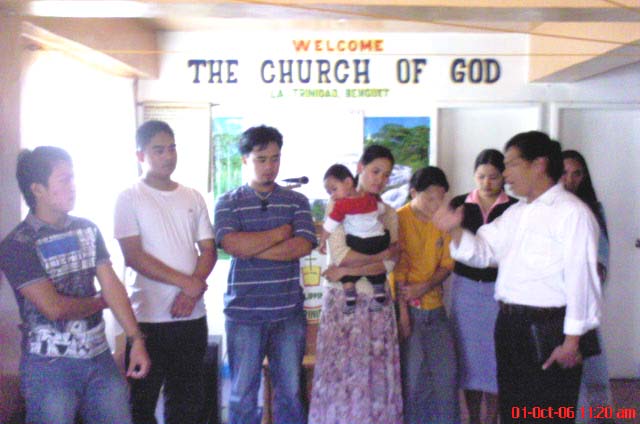
Noong Oct. 1, 2006 lumipat ang Iglesia ng Dios sa La Trinidad sa kanilang bagong panambahan sa JA #221, Km. 3, Pico, La Trinidad, Benguet. Tinawag namin itong Mt. Zion sapagkat nasa itaas ito ng burol Dito nakatira si Tatay Rodrigo Baniza ang unang bunga ng Radio Ministry. Pumayag siya na dito na kami manambahan. Gumawa kami ng pansamantalang panambahan sa gilid ng kanilang bahay. Tolda ang ginawa naming bubong at sako ang inilagay naming dingding. Masaya kaming sumamba sa araw na 'yon sapagkat nakapagbalik loob si Sis. Ayesa Vega at muling lumapit si Tatay Rodrigo. Ako (Bro. Jet) ang naging Sunday School Teacher at naging preacher. Si Sis. Wilma(white dress) ang naging deaconess. Nagbigay naman ng tanging awit si Sis. Lovelyn Hogat. Inaanyaahan namin kayong dumalo tuwing Linggo sa oras na 9:30 hanggang 11:30 ng umaga.

Sunday, October 08, 2006

MATTHEW JULIAN HOGAT'S DEDICATION

Inihandog ni Sis. Lovelyn at ng kanyang asawa ang kanilang pangalawang anak noong Oct. 1, 2006. Kasama ang kanyang mga ninong at ninang sa larawan.

Friday, October 06, 2006

HOW TO FIND SALVATION

Salvation seems to be a hidden treasure to those who have not found it, nevertheless we have found that no one will fail to find it if diligent search is made according to the light of the Holy Bible!

How to find Salvation is like searching the precious metals that are hidden away in the earth; in order to be successful in obtaining them, there must be some knowledge of the location and whereabouts of the metal, then a calculation made as to the cost and expenses, and a full knowledge with the best methods by which to proceed. In the mining business there are many things to get ready before the real digging starts. It is just so with the work of salvation; it is necessary first to find out its direct cost, then carefully consider the matter as to whether or not you are willing and determined to meet the conditions offered, upon which it can be had, and there will be no failure.

It is God who owns the mine of Salvation, and He has sent out an invitation. To everyone to come out and search out the riches. “Whosoever will may come”, and “they that seek shall find”. God will help each one to find the treasures. He has given the New Testament which tells all about how to find this great treasure of Salvation.

The greatest of wealth cannot be found without digging and searching for it. If you do this Salvation is yours. This is how to find Salvation! May God bless you! Amen!

Monday, October 02, 2006

ANG AKING PATOTOO - Sis. Daisy Sevellena

Purihin po ang ating mahal na Panginoon. Ibig ko Siyang pasalamatan sa kabutihan at kadakilaan Niya sa aking buhay. Maraming salamat sa ating Panginoon na maibahagi ko rin po yong himala na ginawa ng ating Panginoon sa aking buhay, na dati rin akong isang makasalanan, ngunit nang ako'y makakilala sa ating Panginoon ay binago Niya ang aking buhay. Nagkaroon ng kabuluhan ang aking buhay sa harapan ng Dios. Ibig ko pong ipahayag sa inyo ang aking buhay noong ako ay hindi pa nakakakilala sa ating Panginoon at hindi pa nakapakinig ng kanyang Evangelio.

Ako ay ipinanganak sa bansang Malaysia, doon na rin ako lumaki, bale taga Mindanao po ako. Subalit hindi ko kapiling ang aking mga magulang. Ang lola ko ang nagalaga sa akin, kaya laki ako sa lola. Lumaki ako at nagkaisip na hindi ako nakadama ng pagmamahal ng mga magulang. Solong anak po ako. Naging rebeldeng anak ako napabarkada, sinungaling, mabisyo at umuuwi ng dis oras sa gabi. Pinag-aral ako ng lola ko ng nursing ngunit hindi ko natapos ito. Hanggang dumating yong panahon na pinalo ako ng Panginoon. Binigyan ako ng pagsubok sa buhay. Naranasan kong magmahal sa isang lalaki na hindi naman pala kami puede sa isat isa at dahil doon nabalitaan kong siya'y nagpakamatay. Sa mga oras na yon naging magulo ang isip ko. Naisipan ko din ang magpakamatay. Salamat na lang sa Dios na may malapit akong pinsan na pinayuhan ako na huwag kong gawin ang bagay na iyon. Gusto kong magpakamatay dahil halos lahat ng kamaganak ko, ako ang sinisisi sa pagkamatay niya.

Nagkaroon ako ng pagkakataon na makaalis sa bahay namin at sumama ako sa isa kong tita sa pagluwas sa Myanila. Pumasok ako sa promotion at doon ko nakilala si Laila na dati ng tumanggap sa Panginoon. Marahil niloob ng Dios na mawala ang promotion at nagpasya si Sis. Laila na pumunta kami sa lugar ng Paniqui, Tarlac. Doon ko nakilala sina Bro. Jet at Sis Judith na tunay na mga naglilingkod sa ating Panginoon.

Purihin ang Panginoon sapagkat isa sila sa ginamit ng Panginoon upang magkaroon ng kabuluhan ang aking buhay. Sapagkat inilapit ko sa Dios ang aking buhay at hiningi ko sa Dios ang kapatawaran ng mga nagawa kong mga kasalanan. Sumampalataya ako sa kanya na ako'y pinatawad sa lahat ng kasalanang ginawa ko. Labis akong nagpapasalamat sa ating Dakilang Dios na binigyan nya ako ng kalakasan sa buhay kong ito upang magpatuloy. Alam ko na hanggat narito ako sa mundong ito hindi ako pababayaan ng Dios. Kaya't huwag tayong manghimagod sa paglilingkod sa Kanya. Matuto tayong magtiis sa mga pagsubok sa sanglibutan ito. Kumapit tayo at magtiwala sa Kanya dahil walang ibang makapangyarihan sa lahat kundi Siya lamang. Purihin ang Panginoon.

(Si Sis. Daisy ay ginagamit ng Panginoon ngayon sa ating Radio Ministry bilang anchorwoman ng The Way of Truth Broadcast)

Saturday, September 30, 2006

HOW TO UNDERSTAND GOD'S WILL

In order to do God's will we must first know his will. In order to have real satisfaction, rest, and contentment in the Christian life and there is no true rest outside the Christian life—we must have the full assurance that we are doing the will of God. The soul that loves God can not be satisfied with anything less than this. As long as there is a doubt, there can not be perfect contentment. We must have a perfect knowledge of God's will concerning us, or else we shall not fully know we are doing his will.

Many are saying, "I would gladly do God's will if I only knew what is his will." Such ones have not reached that nearness to God that they should. There should always be a clear and definite understanding between God and his children. "My sheep," Jesus says, "hear my voice"; and we know that God hears the voice of his children. We can talk to God and God to us; consequently, there can be understanding between us. You can live close enough to God to know his will—not merely to suppose his will or take it for granted, but to know it because he told you. A man's employees may suppose they are doing what he wants them to do, but this does not give them full assurance. It is only when they have been in his presence and heard him express his will that they know they are doing it. You can know God's will. You need not spend one day without knowing you are in his order.

The Scripture says, "Wherefore be ye not unwise, but understanding what the will of the Lord is." Eph. 5:17. In the verses preceding this one, we are told to walk circumspectly and to redeem the time. We need to know God's will that we may use every opportunity to the greatest advantage. To pass along day after day without a definite knowledge of being in the will of God or without taking much thought about it or earnestly seeking to know it, is living on entirely too low a spiritual plane. God wants you to come up higher—high enough and close enough to know his will. Has not God purchased you? You are his servant, his bond slave. You are to do everything you do for him. He who has men in his employ expects them to do his will. They do not go out a single day ignorant of his will. They do not always wait to be told what to do, but they make inquiry. With many there may not be enough earnest seeking after God to know his will.

In order to know God's will there must be a perfect consecration to God. The soul must lay down her own will and present herself before God as much as to say, "I give up my way and will forever to be shine and shine alone; to love thee and serve thee; to do thy whole will now and forever." There must be humility before God; a deep inner consciousness of your nothingness and your inability to accomplish anything in life of yourself. "The meek he will guide in judgment." We must be meek and humble before the Lord and confess that we are dependent on him and that life will be an utter failure unless he wills and guides and plans and works in us and with us and for us.

There must be great love to God and an earnest desire to know his will. Without strong desire to know God's will you can never learn it. It is those who desire that obtain answers to their prayers; and that desire must be really great. You must seek to know. Where there is great desire, there will be earnest seeking but there will not be earnest seeking without fervent desire. The desire must be so intense that you feel as if you must know. You must feel that you can not get along in life without knowing God's will. You can not be of any service to him without having knowledge of his will. You must also have faith. When you ask God to teach you his will, you must believe he will do it, and he will do it. When he begins to unfold his will, you must move in his order without doubting or questioning. He will guide you and direct your every step, and you can know that you are doing the very thing God wants you to do. Bless his name! Such a life is heaven here.

(Taken from the Church of God Reformation)

Thursday, September 28, 2006

O MAN OF GOD

I will be talking especially with every child of God in this gathering who came to fellowship with us in our yearly observance of the festival of the CHURCH OF GOD in the PHILIPPINES. My beloved parents, brothers, and sisters and friends. I have a good piece of oration which I would like to share to you this very moment which is entitled “O Man of God”. This is a challenge to every man or woman of God in this audience. I hope it will also be of help to someone who have not yet accepted Jesus Christ as his or her Savior.

O man of God, you who are justified, regenerated by the blessed Holy Spirit, a member of the family of God which is the Church of God, to you I give this precious message: O man of God, you are a pilgrim on this earth: this world is not your home! You are a citizen of heaven. Sooner or later your pilgrimage will be over and then be home at last. So take heed to what I will say. If not, I am afraid your right of heaven might be forfeited.

You are a child of the King: Every Sinner is a Child of the devil. But you are born of God. You do not commit sin because God’s word is alive in your heart. There is a great possibility for a true Christian not to commit sin through the help of God. Because a free human agent and not a robot there is also the possibility for him to sin. This is the reason I stand before you to warn you and advice through the authority of the Word of God.

The greatest enemy of our souls is the devil. He is the god of this world. He uses the things of this world to get people to his side and rebel against the God of the universe. Once he gets people to be covetous and places in their hearts the love of money, he has won the battle; for the love of money is the root of all evil. Man of God, I am here warning you: those who want to get rich will fall into diverse temptations and snares and into many hurtful lusts which drawn men into destruction and perdition. Covetousness will eventually cause one to err from the faith and finally apostatized.

Man of God, fight the good fight of faith. Be sure you are always on the winning side. Be sure you have the witness of the Holy Spirit with your Spirit that you are a child of God. Testify for your salvation and your faith on the atoning blood of Christ. The devil is overcome by the blood of the lamb and by the word of your testimony; and love not your lives into death.

Man of God, show forth the evidence of your salvation not only by your words but also by good works. Follow after righteousness, godliness, faith, love, patience, meekness. The world scarcely convinced to believe the gospel because the lives of the professing Christians do not satisfactorily show forth pure religion which is undefiled before God.

Man of god, you are not under the law of the Jews but under the gospel of Christ Jesus. What He had taught the disciples is a law unto us. He had commissioned to preach the gospel unto all nations, teaching them to observe all things whatsoever He commanded them. Therefore, you have to keep Christ’s commandments without spot, unrebukable until the appearing of our Lord Jesus Christ.

Man of God, the life of godliness with contentment is the greatest gain on earth. We brought nothing into this world and we can carry nothing out. A holy life is the only what that will bring a man to glory: What Shall it profits a man if he gained the whole world and loss his soul? Nothing: The soul is the most precious property of a man. Nothing can be given in exchange for it. It will either be lost forever and ever in be given in exchange for it. It will either be lost forever and ever in hell or be crowned in heaven. If he chooses the devil to serve by living in sin, then, he chose hell to be punished eternally.

No one is created to go to hell. God wants everybody to go to heaven; there are two ways before you. One is going straight to heaven. The other way is going down to hell. Man of God, you have chosen the straight and narrow way. It is called the way of Holiness; hate unclean shall not err therein, but the redeemed shall walk therein: and the ransomed of the Lord shall be for those: the way faring men, though fools shall not err therein; but the redeemed shall walk therein: and the ransomed of the Lord shall return and come to Zion (the Church of God), with songs and everlasting joy upon their heads: they shall obtain joy and gladness, and sorrow and sighing shall flee away.

Wednesday, September 27, 2006

26TH WEDDING ANNIVERSARY of Bro. Jet and Sis. Wilma Batalla

Binabati namin si Bro. Jet at Sis. Wilma sa kanilang 26th wedding anniversary sa araw na ito, Sept. 27. Sila ay biniyayaan ng apat (4) na anak na sina Jesus Josef(25), Emily Joanna(21), Jeremy John(17) at si Jethro James(13). Biniyayan din sila ng isang apo na si Josef Stephen(10 months old, visit his web blog at http://jobat.blogspot.com) anak ni Josef at Stefie Ibuan. Idalangin natin na lalo silang pagpalain sa material lalo na sa espiritual.
(Kung mayroon kayong gustong batiin sa kanilang kaarawan at wedding anniversary mag e-mail lang po sa inyong lingkod. Ang e-mail address ay, jet_batalla@yahoo.com.

Monday, September 18, 2006

POLITY OF THE CHURCH OF GOD - Daniel Sydney Warner

Polity of the Church of God (1876)
Daniel S. Warner

The term ekklesia, from which we have church, is a generic term, and applies to any assembly, good or bad, temporal or permanent. In Acts 19 it is used with reference to two different assemblies, and neither religious. In verse 39 it refers to a lawful tribunal; in verse 32 and 41 it applied to a confused concourse.

We read of an ekklesia, or church, in the New Testament, which is qualified as being "of God;" hence among the various societies in the world there is one of which God is the author. Polity means form of government. Now, as law, order or government is essential to the existence of any organism, we ask what government has God enacted for his church? That the New Testament was given for that purpose and is all sufficient is only denied by ignorance or bigotry.

What, then, is the polity of the New Testament?

The Church of God was designed to fill all nations; but, unlike the Jewish worship, she is not required to convene in one place to offer her sacrifice of praise and obey the commands of her head and Savior. But that she could everywhere enjoy all the benefits and perform all the duties of the church organic, a full corps of officers was authorized in every city, town and community that formed a central point for worship. All in reach of any such point, who were recognized as disciples, constituted the Church of God in that locality. Nothing is said of the induction or admittance into those local churches. God admits into the body (Acts ii. 4) through the door of Christ (John x. 9; Eph. ii. 18), by the spirit (Rom. viii. 15; 1 Cor. xii. 13) on condition of faith (Rom. v. 1-2). By their fruits they were recognized as disciples, and consequently integral parts of the Church of God in that locality.

I shall first attend to the polity of those local churches. We find it was administered by elders or bishops and deacons. Of the latter I shall say nothing; of the former I notice that they are identical (Titus i. 5-7; Acts xx. 17; compare with ver. 28, where "overseers" is from episkopous, elsewhere translated bishops). Elder refers to the rank, bishop the duties. Paul says (1 Tim. v. 17), "Let the elders that rule well be counted worthy of double honor, especially they who labor in the word and doctrine." From this we learn that some elders labor in word and doctrine, others not. The former, I understand, are called of God to preach the word. From this and other Scriptures we also learn that elders have ruling authority; hence the New Testament polity is not congregational. And if I am to understand the term "Presbyterian" as submitting the entire and absolute control into the hands of the elders, I am unwilling to adopt it as expressive of the New Testament polity. That elders are vested with ruling authority is clear; but Peter says (1 Pet. v. 3), they should not be "as lords over God's heritage (margin 'overruling'), but being ensamples to the flock." If Paul exhorts (Heb. xiii. 17) to "obey them that have the rule over you." Peter also says (1 Pet. v. 5), "Yea, all of you be subject one to another and be clothed with humility."

Thus we see there is but little red-tape authority in the church. Elders are to rule by their holy example and love, watch over and feed the flock, preside over business meetings, appoint meetings of worship, lead the same, or invite some one to do so. "If a man be overtake in a fault," not only are the elders under obligations to look after him, but all "Ye which are spiritual restore such a one in the spirit of meekness." (Gal. vi. 1). This makes every brother the keeper of every other brother. Love and sympathy make this the duty of all. Besides, it is the duty of elders ex-officio.

In Matt. 18, the last step in trying to restore an offending brother is to "tell it to the church." He needs the sympathies and prayers, as well as the "meek admonitions of all that are spiritual" (Matt. xviii. 17-20; Heb. xii. 13; James v. 16). What human heart could withstand such an array of kindness, sympathy and love? Few, indeed, would not melt down and humbly confess their faults. But if he will not relent, "let him be unto thee as a heathen man and a publican." That is, he having put himself out of the church by becoming a sinner, and having been unsuccessful in restoring him, withdraw your fellowship from him. Thus we see officers and members counsel and work together in harmony to maintain the peace and advance the cause of Zion. Hence the New Testament polity, according to my mind, is not exactly Presbyterian, but simply Scriptorial; a government based on the "perfect law of liberty and all fulfilled in love."

I now pass to its general government of the church. I say "the church," because those co-ordinate churches constitute the one Church of God operating in different localities. They have some individual concerns, but in most respects they merge into one common brotherhood. They are called out of the world to serve the same Master. Their cause is one. They all have the same faith and are required to walk by the same rule: each one must subserve the general good. Now, how can these churches be kept uniform in faith and practice? How can each church and individual act so as to promote the general good, without the superintendence of some power over all? For these purpose popes, archbishops, general presiding bishops and presiding elders have been installed. But the New Testament has prescribed a different plan. Let us see how difference was adjusted and uniformity and harmony maintained.

In its complete moral conquest of the world, Christianity had to encounter three great antagonists--Judaism, Paganism and Orientalism. With Judaism it had to maintain a double conflict. Stephen and others had fallen in conflict with it as an external foe. But as an internal foe it was far more dangerous. It forbade Christ from demanding homage of, and proclaiming salvation to, the whole human race, as the author of the one true and universal religion. Forty years had passed and the light of the gospel was yet confined to the lost sheep of the house of Israel. The Apostles, it appears, had forgotten the extent of their commission, and Christianity was viewed as the completion of Judaism. But finally Samaria receives the word which was an innovation upon Jewish prejudice. And now Peter actually goes into the house of men uncircumcised, eats with the and preaches to them the gospel. What an insult to the Christian Jews. Peter must appear before the Eldership in Jerusalem and answer to charges. This he did, and after rehearsing the whole matter, an action was taken justifying Peter and glorifying God, forgiving salvation to the Gentiles. We have no record of any other business transacted at this first Eldership of the Church of God of Jerusalem, A. D. 41 (Acts 10 and 11).

Though Peter had taken the first step in the comprehensive view of Christianity, Paul was destined to become the great champion of this principle of universal liberty in Christ. Through his arduous labors Christianity soon spread to a wide extent in the Gentile world. This awakened much jealousy among the Jewish Christians. They saw that Christianity, instead of being the purest form of Judaism, was rapidly becoming an indiscriminating religion in which the Jewish element would soon be absorbed and lost. Paul was at once recognized as the author of this great revolution which threatened the extinction of all they had been taught to hold sacred. At Antioch the jealousy of the Jews seems to have kindled into a flame of indignation. Peter gave way to the strong tide of prejudice; and when Barnabas, Paul's colleague, "was carried away with their dissimulation" (Gal. ii. 11-14). This was a trying time for Paul. The Judahizing party was, doubtless, much emboldened by "certain men which came down from Judea" and taught that circumcision was necessary to salvation (Acts xv. 1). The great battle now came to a crisis, and after much disputation it was found necessary to appeal to the Apostles and elders at Jerusalem for a decision of the question. Paul, Barnabas and certain others were sent to lay the matter before the body. Seventeen years had elapsed since Paul had left Jerusalem with all the zeal of a Pharisee to destroy the Christians at Damascus. Since then he had twice, as a Christian, entered the holy city; but both visits were short and attended with danger (Gal. i. 18; Acts xi. 29-30). Now once more he comes to defend his principles and practices against an increasing torrent of opposition, which had interrupted his distant missionary labors, but the fountain head of which was among the Pharisees at Jerusalem. "The great question of liberty or bondage for all future ages was to be decided." A question that threatened the subversion of the whole plan of redemption. So eager were the Judahizing part for the conflict that immediately following the reception of Paul and Barnabas by the church at Jerusalem, some of the Pharisee Christians "rose up" and insisted that it was needful to circumcise the converts and command them to keep the Law of Moses. This was a direct attack upon the whole course of Paul's procedure among the Gentiles. "The Apostles and Elders, therefore, came together to consider of this matter" (Acts xv. 6). This was the second Eldership of the Church of God. There was some pretty warm discussing, I judge (ver. 7).

Peter is the first who is honored with a synopsis of his speech in the inspired journal. He takes a decided stand against Judaism; reminds them those converts in Syria and Cilicia under Paul and Barnabas were not the first Gentiles admitted into the kingdom, but that a good while ago he had been chosen to begin this work at the home of Cornelius, where God had given unmistakable evidence that he was no "respecter of persons." He pronounces the law an intolerable yoke, etc. He was followed by Barnabas and Paul. There was great silence in all the multitude while these zealous missionaries appealed to the miracles God had wrought by them as evidence that the gospel extended to all nations and every creature. Thus they proved the legality of their course by the same evidence that established the divine mission of Christ. But the voice of James the First, "and one of the pillars," who, with "austere features, the linen ephod and bare feet, the long locks and unshorn head of a Nazarite, resembling the ancient saints," would have much weight with the Judahizing party. And such, according to tradition, was the man who now came forward and deposed that the Jewish law was not of universal and perpetual obligation. After referring to the arguments of Peter, he adduced a passage from Amos as positive proof that under the light of the gospel the "residue of men," even the "Gentiles," should seek after and find God.

These four speeches having clearly established the fact that Judaism was to be superseded by Christianity, they were now ready for the question. James concludes with the following motion: "That we trouble not them from among the Gentiles have turned to God," etc. (Acts xv. 19-20.) This was [2] unanimously adopted and reduced to writing (verses 22, 23). And as THE CHURCH ADVOCATE was not yet published, a committee, consisting of Judas and Silas, was deputed to carry these decrees to Antioch; which, when they had delivered to the church, caused much consolation, and, doubtless, put an end to the whole controversy there.

Soon after this Paul and Silas set out together to visit all the churches and "see how they do." And as they went through the cities they delivered them the decrees for to keep. that they were ordained of the "Apostles and elders at Jerusalem." So were the churches established in the faith, i.e.--to one uniform faith (Acts xvi. 4-5).

The second item of business I shall notice was this: At this meeting it was agreed that Paul and Barnabas should labor among the Gentiles, and James, Peter and John among the Jews (Gal. 2. 9). This precedent teaches that ministers should be assigned to the various fields by the assembled Eldership, and not by a presiding elder, neither as the churches independently may "hire" them.

Item second: The reports of Paul and Barnabas to that body furnish an example for ministers' reports as part of the business of an Eldership.

Item third: We are told at this meeting there was provision made to relieve any part of the church that was in want (Gal. 2. 10).

Observation fourth: We notice that they depended upon the spirit to dictate all their business (Acts 15. 28). Were this now carried out there would be much less business transacted for the gratification of prejudice and jealousy.

Fifth: We learn from James' speech the true business of an Eldership is not to legislate, but to appeal to the word of God as the standard by which to settle all controversy.

Sixth: It appears (Acts 15. 22) that the whole church convened with the Apostles and elders, and enjoyed the privilege of expressing themselves. Hence it is proper to extend to all the brethren the courtesy of an advisory seat.

Seventh: The business, however, seems to have been transacted by the Apostles and elders (Acts 15. 6; 16. 4). But the Apostles have ceased, hence it devolves upon the Eldership. Hence the propriety of the name Eldership meeting for those convocations. Thus we find a precedent for the name and nearly all the business of our present Elderships in those first two held with the Church of God in Jerusalem. There are no directions as to how frequently the Eldership should convene; hence, it is left to circumstances and the judgment of the body; as is also the propriety of dividing into districts Elderships for convenience, and then holding a less frequent general Eldership meeting to consult upon general interests and maintain universal harmony.

D. S. WARNER.
Seward, Neb., Dec. 15, 1874.

Thursday, September 14, 2006

ANG PANTUBOS

Isa sa mga dakilang doktrina at katotohanan sa Biblia ay ang doktrina ng "Pantubos". Minsan lamang matatagpuan ang salitang "Pantubos" sa bagong tipan. Ito ay nasa aklat ng mga taga Roma 5:11. Ano ang kahulugan ng salitang "Pantubos"? Ito ay ang pampalubag loob na inihandog sa banal na katarungan sa pamamagitan ng kamatayan ni Cristo para sa mga kasalanan ng sanglibutan. Sa bisa nito, lahat ng mga tunay na nagsisi at sumampalataya kay Cristo ay personal na pinagkaisa sa Dios, pinalaya sa kabayaran ng kaniyang sala, at naging tagpagmana ng buhay na walang hanggan".

Ang buhay, dugo, pagdurusa at kamatayan ni Cristo na inihandog ay upang tugunin ang banal na katarungan ng Dios na hindi maaaring gawin ng tao sapagkat pagbabayaran niya ito sa walang hanggang kaparusahan sa impierno. Ito ang pantubos ni Cristo na ginawa. Dahil sa kasalanan na ginawa ng tao, naipagbili niya ang kaniyang sarili sa kasalanan. Dahil dito, Siya'y naging alipin ng kasalanan (Juan 8:34).

Tuesday, September 12, 2006

LIVE BROADCAST BY SIS WILMA